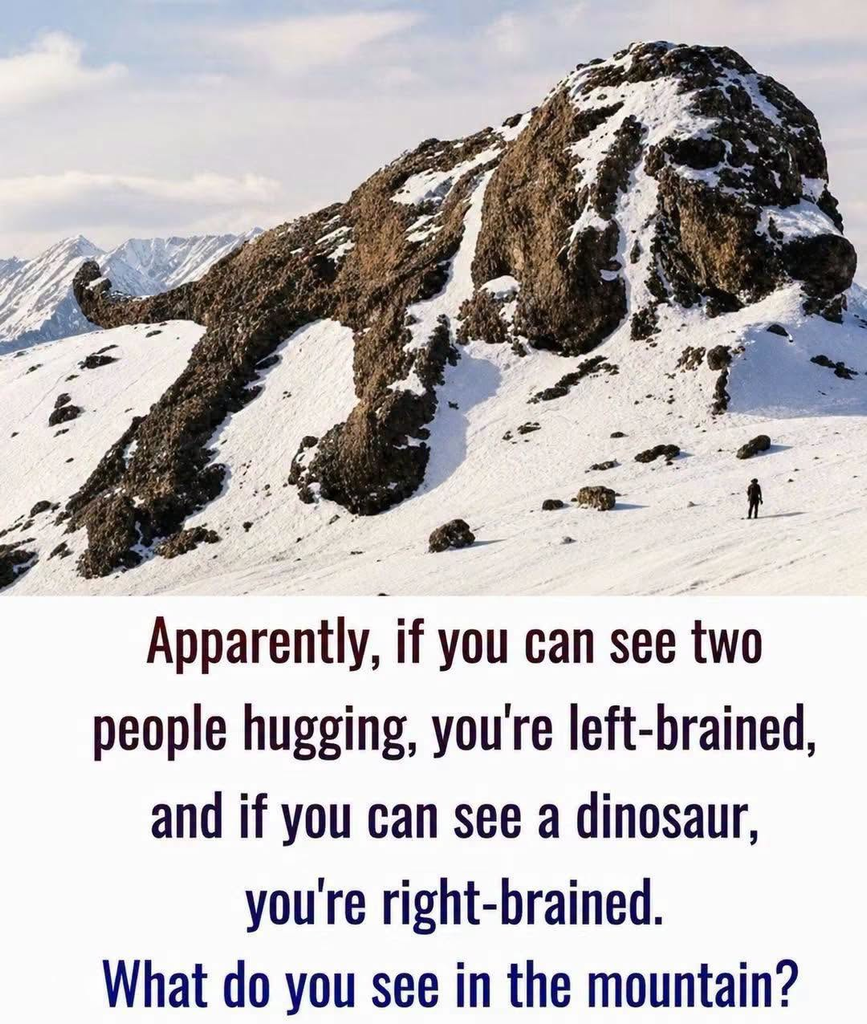
The image above shows a snowy mountain landscape. The rock formation has a distinct shape that can be interpreted in different ways. The text suggests that if you see two people hugging, you are left-brained, and if you see a dinosaur, you are right-brained. It then asks a simple question: what do you see in the mountain? This type of visual test is popular on social media. It is fun, engaging, and sparks conversation. But is there any truth to the claims about brain dominance?
The Left-Brain and Right-Brain Myth
The idea that people are either left-brained or right-brained is a myth. It became popular in the 1960s based on research into how the brain’s hemispheres process different tasks. However, modern neuroscience has shown that this is an oversimplification. The two hemispheres work together for almost every task. There is no evidence that a person is dominant in one hemisphere or the other. What you see in a mountain has nothing to do with which side of your brain is leading.
What the Image Actually Shows
The rock formation in the image is a natural shape. It resembles a large animal, possibly a dinosaur, with a head and a body. Some people might also see two figures embracing. The ambiguity is what makes it a good visual puzzle. It is a classic example of pareidolia, the tendency to see recognizable patterns in random objects.
Why People See Different Things
People see different shapes in the same image because of selective attention. The brain cannot process every single detail at once. It prioritizes certain visual cues based on your past experiences, your mood, and what you are looking for. Someone who loves animals might spot a dinosaur immediately. Someone who is thinking about relationships might see the hugging figures. There is no right or wrong way to see the image.
The Fun of Playing Along
Even though these tests are not scientifically accurate, they can still be enjoyable. They encourage self-reflection and can be a great conversation starter. They also remind us that perception is subjective. Two people can look at the exact same image and see completely different things.
The Bottom Line
The next time you see a picture asking you to identify a shape in a mountain, enjoy the challenge. Just remember that the real magic lies in the incredible way our brains work, not in the hidden meaning of the image. Your personality and cognitive style are far too complex to be determined by a single glance at a rock.
What did you see first in the mountain? Share your answer in the comments below.